A Study on Vent Mast Hazardous Zone Determination Applying EI 15 under the Revised IGF Code
This is an Open-Access article distributed under the terms of the Creative Commons Attribution Non-Commercial License(http://creativecommons.org/licenses/by-nc/3.0) which permits unrestricted non-commercial use, distribution, and reproduction in any medium, provided the original work is properly cited.
Abstract
The revised IGF code allows the application of the fuel's 50% LFL contour to define reduced Zone 1 extent around vent mast but provides no guidance on dispersion modeling or release scenario definition. Therefore, engineers often refer to IEC 60079-10-1, which suggests a leak hole size equal to 10% of the PSV orifice area. For large LNG fueled vessel's PSV, this assumption produces unrealistically high release rate and excessively conservative hazardous zone extent. This study proposes a practical alternative approach applying the El 15 Level framework (Level I ~ III), which determines leak hole size based on Individual Risk (IR) and ignition probability. By mapping El 15 equipment type to PSV, more realistic and risk consistent leak hole size is taken while maintaining compliance with IGF code. Two-phase release simulation using DNV Phast and in:Flux CFD dispersion modeling tool were conducted to compare hazardous zone extent from IEC approach and EI 15 based leak hole size. Results show that El 15 leak hole size substantially reduce fuel's 50% LFL contour, below 3 m, while preserving alignment with accepted risk principles. The methodology clarifies scenario selection under the revised IGF code and supports more practical hazardous zone extent design for LNG fueled vessel.
Keywords:
Vent mast, Hazardous area classification, EI 15, IGF code, Dispersion modeling, LNG fueled vessel1. Introduction
The vent mast typically produces the largest hazardous zone extent among individual release sources on LNG fueled vessel (Pemberton et al., 2012). It is connected to the downstream side of the fuel tank PSV and discharges flammable gas to a safe elevation above the deck. Under the previous IGF code (2024 Amendment), Section 12.5 did not explicitly define vent mast (IMO, 2024a). Therefore, engineers interpreted the general term ‘gas or vapour outlet’ as vent mast and applied hazardous zone extents of 3 m (Zone 1) and 4.5 m (Zone 2), consistent with the ‘cargo vapour outlet (small volume)’ example in IEC 60092-502 (IEC, 1999). However, it has also been argued that, given the potential magnitude of flammable fuel release, the ‘cargo vapour outlet (large volume)’ example that specifies 6 m (Zone 1) and 10 m (Zone 2) provides a more appropriate basis.
The revised IGF code (MSC 109th) resolves previous ambiguity by explicitly defining vent mast and adopting these larger hazardous zone extents of the ‘cargo vapour outlet (large volume)’ (IMO, 2024b). Because this significantly expands the required zone extents compared with the previously required Zone extents, the code permits reduced Zone 1 extent using dispersion modeling based on the fuel`s 50% LFL contour. However, the IGF code does not provide guidance on dispersion modeling or appropriate release scenarios.
Dispersion results depend strongly on the assumed PSV leak hole size. IEC 60079-10-1 is explicitly referenced in the IGF code and the IMO’s IGC code as a supporting standard that may be used when performing hazardous area classification. It specifies 10% of the PSV orifice area (IEC, 2020), but for large LNG fueled vessel's PSV this produces discharge rates that are unrealistically large, yielding excessively conservative hazardous zone extents. This limitation also identified by the Korea Register (KR) report (Kim, 2025). Because the IGF code does not mandate a specific leak hole size, alternative design approach should be used.
Accordingly, this study applies the other international standard El 15 about hazardous area classification recognized under IMO alternative design provisions to derive risk-based leak hole size and suggests a methodology for defining reduced Zone 1 extent consistent with the intent of the revised IGF code. Among the four major international standards for hazardous area classification (IEC 60079-10-1, API 505, NFPA 497, and EI 15), EI 15 is uniquely distinguished as the only standard that provides design guidelines based on DNV Phast simulation results. By offering realistic hazardous area extents from an end-user perspective rather than a purely regulatory standpoint, it has the advantage of minimizing the unnecessary application of explosion-proof equipment. Furthermore, its international credibility is well-established, as global oil majors such as Shell and BP adopt EI 15 as their corporate standard for hazardous area classification.
2. Background
2.1 The leak hole size in IEC 60079-10-1
IEC 60079-10-1 recommends assuming a leak hole area equal to 10% of the PSV orifice area (IEC, 2020). This value originates from technical book published by IChemE (Cox et al., 1990), where valve leaks were categorized as minor leaks and approximated as one tenth of the pipe area. IEC subsequently adopted this heuristic.
However, chapter 10 of the same reference classifies leak hole size into twelve categories between 0.1 mm2 and 250 mm2 (IEC, 2020). For large LNG fueled vessel's PSV, applying 10% of the orifice area yields leak hole sizes for greater than 250 mm3. IEC 60079-10-1 does not address such cases, resulting in unrealistic release predictions and overly conservative hazardous zone design.
Therefore, relying solely on the PSV leak hole size recommended in IEC 60079-10-1 on the basis that it is referenced in the IGF code is not appropriate, as this approach fails to account for the inherent limitations of the standard.
2.2 Overview of the EI 15 standard
El 15 is an internationally recognized hazardous area classification standard widely applied in European and global industries (Quensnel et al., 2024). Among the global major hazardous area classification standards like IEC 60079-10-1, API 505, NFPA 497, and El 15 (Givehchi et al., 2016), the distinguishing strength of El 15 lies in its emphasis on practical engineering judgment supported by extensive operational experience by oil majors (Sherwen, 2015).
SOLAS Regulation II-1/55 permits alternative design approaches based on ‘other recognized engineering or industry standards’, a category that includes El 15. It is also referenced in the guidelines for natural gas fueled ship projects (SIGTTO et al., 2014), applying its relevance for LNG fuel system design.
In addition, because the oil majors (BP, Chevron, ENI, ExxonMobil, Shell, etc.) that contributed to the development of EI 15 are also active in the offshore sector, where EI 15 is applied for hazardous area classification, the standard cannot be considered entirely unrelated to the marine industry.
2.3 Leak hole size determination in EI 15
EI 15 determines the secondary grade of release`s leak hole size using risk-based approach in which release frequency is related to worker exposure. (Equation (1).)
| (1) |
The Pocc represents the probability that a worker is present in the Zone 2 area (EI, 2024). It is calculated as the ratio of the workers annual residence time within Zone 2 to the total annual working hours, assumed to be 8,760 hours. For example, if a worker remains in Zone 2 for 1,920 hours per year-based on 8 hours per day, 5 days per week, and 48 working weeks- then dividing 1,920 by 8,760 yields a Pocc value of 0.22.
The Nrange represents a time weighted value for the number of potential leak sources that could affect a worker while they are present with in a Zone 2 area (EI, 2024). This value is derived by El Research based on the collective operational experience of oil major member companies. As shown in Table 1, worker activities within the facility are broadly categorized into three types. The proportions of these activities during total working hours are then used to calculate a weighted average.

Average number of release sources in Nrange
For example, if a worker spends 30% of their time patrolling in open plant areas, 40% patrolling in congested plant areas, and 30% conducting inspections in areas with multiple leak sources, the Nrange value is calculated as Equation (2).
| (2) |
The value of Nrange can be derived not only from the characteristics of oil and gas operations but also from process conditions and crew work patterns on board vessels.
Thus, both Pocc and Nrange can also be determined for the vessel`s operating conditions, and their product may be used to obtain the corresponding Exp value.
The parameter Pign represents the probability that an ignition source within Zone 2 will lead to ignition (EI, 2024). This value is defined based on the combined operational experience of oil major member companies participating in EI research, as well as incident data reported by HSE UK (Spouge, 2006). As summarized in Table 2 (EI, 2024), ignition sources are grouped into four categories, each associated with a characteristic probability. The Pign value for a given process is calculated by weighting these probabilities according to the proportion of ignition sources belonging to each category.
Probability of ignition for varying sources of ignition strengths
For example, if the ignition sources in a process are composed of 40% Strong, 40% Medium, and 20% Weak sources, the Pign value is calculated as Equation (3).
| (3) |
The previously calculated Exp and Pign values are plotted on the graph shown in Fig. 1, and the risk level is determined according to the zone in which the corresponding point falls. The meanings of Levels I, II, and III are summarized in the legend of the Fig. 1. These levels represent a three-tier classification based on the Individual Risk (IR) values developed by El Research, using 1.0×10⁻⁵ as the reference threshold.
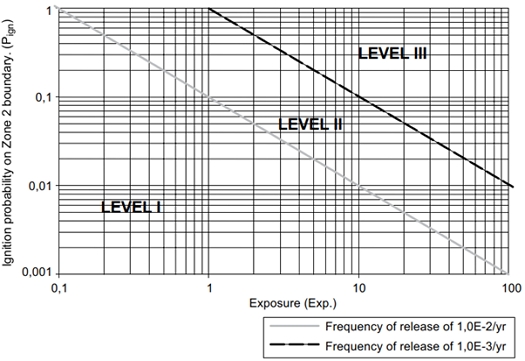
Release frequency (Level) to achieve an Individual Risk (IR) criterion given Exp and Pign
Finally, based on the Level assigned to the process, the leak hole size corresponding to each equipment type is determined using Table 3 (EI, 2024). For example, if a process is classified as Level I, a PSV, which is the type of valve, within that process should be assigned a leak hole size of 1 mm for hazardous area classification purposes.
Equivalent leak hole sizes for a range of release frequencies
This approach yields practical and risk-based leak hole sizes that avoid the excessive conservatism embedded in the fixed assumptions of IEC 60079-10-1.
3. Methodology
This study evaluates hazardous zone extents around vent masts using four release scenarios (Table 4).
Release scenario of PSV based on leak hole size
A representative system comprising an LNG fuel tank, a PSV, and a vent mast is analyzed. Because LNG fuel tank operates at cryogenic temperatures, releases may occur as two-phase flashing jets. Therefore, two-phase discharge rates were simulated using DNV Phast.
DNV Phast provides accurate source term characterization (Gant et al., 2014) but produces inherently two-dimensional dispersion results. Accordingly, the three-dimensional explosive atmosphere geometry and the fuel`s 50% LFL contour were evaluated using in:Flux CFD Tool. It is a fast and reliable CFD tool that has gained widespread adoption in the engineering industries.
The combined use of DNV Phast and in:Flux offers a realistic and technically defensible basis for comparing the four leak hole scenarios.
4. Case study
A representative LNG fueled vessel with a LNG fuel tank, PSV, and vent mast was analyzed (Fig. 2).
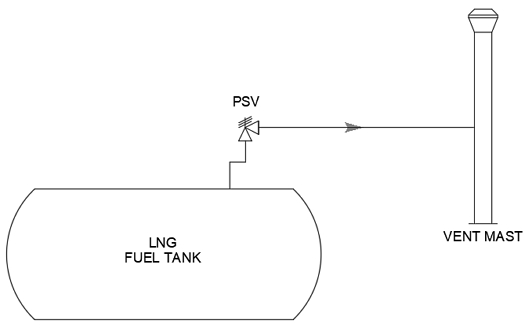
Process scheme of case study
The operating condition of PSV in this case study was applied in Table 5. The operating temperature of the PSV was assumed to be equal to the Boil Off Gas (BOG) temperature, and the orifice cross-sectional area was taken from the PSV calculation sheet.
PSV operating condition
4.1 Two phase release modelling in DNV Phast
Dispersion modeling was performed using DNV Phast under the conditions specified in Tables 4 and 5, and the results are summarized in Table 6.
PSV two-phase release results
Under two-phase release conditions, it was clearly observed that a smaller leak hole area results in a lower mass flow rate.
4.2 Conversion to vent mast tip conditions
Assuming negligible heat transfer during upward transport from the PSV to the vent mast tip, the fluid temperature and density at the vent mast tip were assumed to be equal to those at the PSV discharge. According to Note 1 of Section 6.3.4 in IEC 60079-10-1, cryogenic fluids, even if lighter-than-air under normal conditions, exhibit heavier-than-air behavior immediately upon release (IEC, 2020). Unlike lighter-than-air fluid, heavier-than-air fluid tends to accumulate near the floor upon release, forming a wider hazardous zone extent. So, based on this, assuming low-temperature conditions for cryogenic fluids provides a conservative estimate of the hazardous area extent, which is the rationale for this assumption. Under this assumption, Equation (4) applied.
| (4) |
- ρ : Fluid density (kg/m3)
- A : Cross sectional area (mm2)
- V : Velocity (m/s)
Applying Equation (4), in:Flux input data for vent mast tip was derived as shown in Table 7. And, the external wind speed affecting the vent mast was assumed to be 2.5 m/s from all directions—east, west, south, and north.
in:Flux Input Parameters
4.3 Dispersion modeling results
Based on the conditions in Table 7, the contour up to fuel`s 50% LFL of LNG at the vent mast tip was modeled using in:Flux. The results are shown in Fig. 3 and summarized in Table 8.
Isosurface to fuel′s 50% LFL at the vent mast tip for each case
Applying the leak hole size specified in IEC 60079-10-1 resulted in a hazardous zone extent exceeding 6 m, as defined for Zone 1 in the revised IGF code, making it impossible to implement the concept of a reduced Zone 1 in practice. In contrast, using the leak hole sizes corresponding to any Level specified in EI 15 allowed for the practical application of the reduced Zone 1 concept as intended by the revised IGF code. Even when dispersion modeling was applied, the hazardous zone extent could be conservatively set based on the minimum requirement of 3 m.
This indicates that applying the leak hole sizes from EI 15 allows the hazardous extent of Zone 1 at vent masts to be approached in a manner consistent with the values used in the previous IGF code. The only difference under the revised IGF code is that the extent of Zone 2 shall be extended by 4 m beyond Zone 1, rather than the 1.5 m increment used previously.
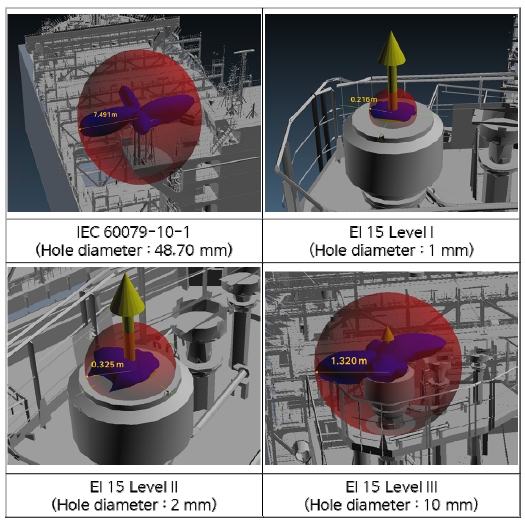
in:Flux results of fuel`s 50% LFL contours at the vent mast tip for each case
5. Discussion
The results of this study clearly demonstrate the technical contradictions that arise when applying the fixed leak hole size assumptions of IEC 60079-10-1 to large-scale LNG-fueled vessel systems. As shown in the simulation results, the 10% orifice area rule yields a mass flow rate of 1,519.02 kg/hr, which is more than 23 times higher than the rate calculated under EI 15 Level III. This extreme flow rate forces the 50% LFL contour to extend beyond 7.4 m, rendering the "Reduced Zone 1" concept of 3 m, as introduced in the revised IGF Code (MSC 109) (IMO, 2024b), physically impossible to implement. In contrast, the risk-based approach of EI 15 provides a robust technical justification for the 3 m Zone 1 radius. Even under the most conservative risk level (Level III), the maximum dispersion distance remained within 1.32 m, proving that the 3 m requirement maintains a significant safety margin while allowing for practical engineering design. The originality of this research lies in establishing a risk-based hazardous area classification process that harmonizes the discrepancy between the IGF Code and IEC 60079-10-1 by utilizing EI 15 as a credible alternative. By integrating worker exposure probabilities (Pocc) and ignition source strengths (Pign) specific to maritime operations, this study moves beyond the "one-size-fits-all" approach and offers a vessel-specific methodology that is both scientifically sound and industry-applicable. This hybrid analytical framework, combining source term characterization via DNV Phast and 3D CFD modeling via in:Flux, provides a defensible guideline for engineers to optimize safety designs without excessive conservatism. Despite these contributions, this study has certain limitations. The assumption that fluid properties at the vent mast tip are identical to those at the PSV discharge ignores potential pressure drops and external heat transfer during the upward transport in the piping. Furthermore, while pure methane (n-CH4) was used as a representative fluid, the actual flashing behavior of multi-component LNG mixtures may vary. Future work will focus on refining the discharge conditions by incorporating internal pipe flow analysis and conducting sensitivity studies under diverse atmospheric stability and wind profiles to enhance the generalizability of the proposed methodology.
References
- Cox, A.W., Lees, F.P. and Ang, M.L., 1990. Classification of hazardous locations. IChemE.
- Energy Institute (EI), 2024. EI Model code of safe practice Part 15: Area classification for installations handling flammable fluids.
-
Gant, S.E., Narasimhamurthy, V.D., Skjold, T., Jamois, D. and Proust, C. 2014. Evaluation of multi-phase atmospheric dispersion models for application to Carbon Capture and Storage. Journal of Loss Prevention in the Process Industries, 32, pp.286-298.
[https://doi.org/10.1016/j.jlp.2014.09.014]

-
Givehchi, S., Zohdirad, H. and Ebadi, T. 2016. Utilization of regression technique to develop a predictive model for hazard radius from release of typical methane-rich natural gas. Journal of Loss Prevention in the Process Industries, 44, pp.24-30.
[https://doi.org/10.1016/j.jlp.2016.08.015]
- International Electrotechnical Commission (IEC), 1999. IEC 60092-502: Electrical installations in ships – Part 502: Tankers – Special features.
- International Electrotechnical Commission (IEC), 2020. IEC 60079-10-1: Explosive atmospheres – Part 10-1: Classification of areas – Explosive gas atmospheres.
- International Maritime Organization (IMO), 2024. IGF Amendment (108th)
- International Maritime Organization (IMO), 2024. IGF Amendment (109th)
- Kim, K.Y., 2025. IMO News Final MSC 109. Korean Register.
- Pemberton, A.K., Thyer, A.M. and Ledin, H., 2012. Ignition hazards and area classification of hydrocarbon cold vents by the offshore oil and gas industry. IChemE, Symposium Series No. 158.
- Quensnel, A., Vyazmina, E., Houssin, D., Beltran, D.T. and Pique, S., 2024. Deliverable 3.6 – Risk assessment review of critical scenarios and hazardous area classification. MultHyFuel.
- Shell., 2011. DEP 80.00.10.10-Gen : DEP Specification Area Classification.
- Sherwen, 2015. EI15 4th Edition, Improvements and Application. IChemE, Symposium Series No. 160.
- Society of International Gas Carrier and Terminal Operators (SIGTTO), Society for Gas as a Marine Fuel(SGMF), 2014. Standards and guidelines for natural gas fueled ship projects.
- Spouge, J. 2006. Leak frequencies from the hydrocarbon release database, IChemE, Symposium Series No. 151.
Jaeyoung Choi: Conceptualization, Investigation, Methodology, Software, Writing – original draft, Writing – review & editing, Minjoo Kim: Investigation, Methodology, Resources, Hyunjun Kwak: Investigation, Resources, Software.